Wall Street · CA Daily Wire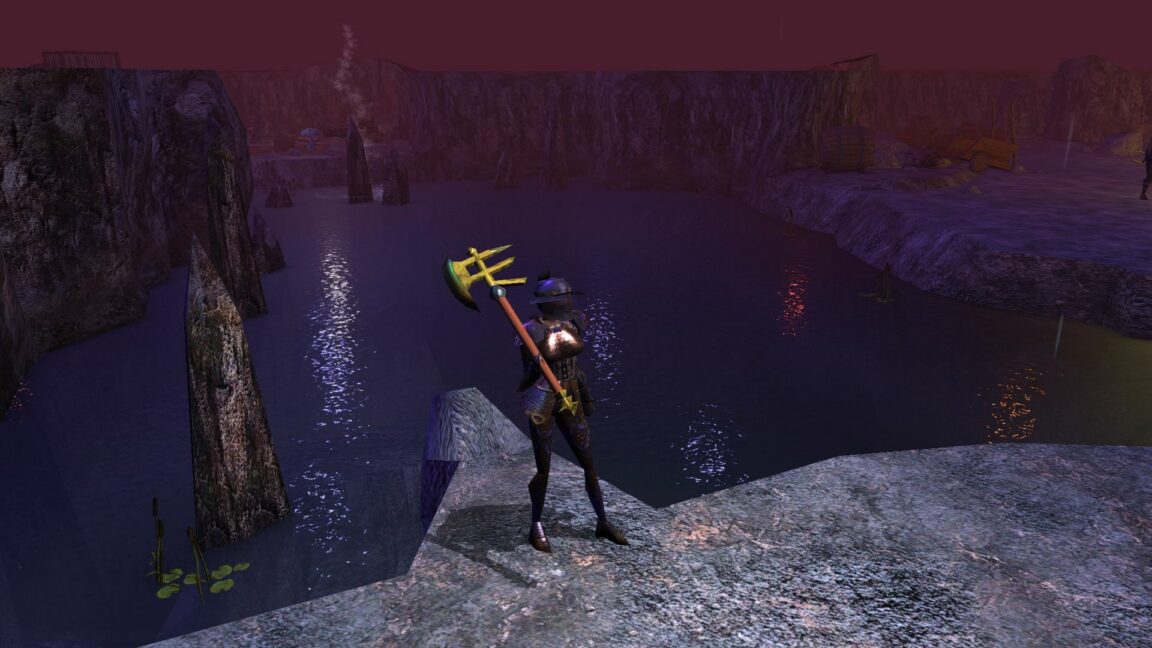
C:\ArsGames The single-player is just OK, but according to the players, that doesn’t matter. Neverwinter Nights is deeply nostalgic for me. There's something about this era of PC game graphics.
Credit: GOG Neverwinter Nights was made by the studio that produced seminal RPGs Baldur’s Gate , Star Wars: Knights of the Old Republic , Mass Effect , and Dragon Age . It sold well and was critically acclaimed at launch. Yet, somehow, it has not been canonized in most gamers’ minds over the decades the same way the games that came before and after it were.
Nonetheless, more than two decades later, it still has a tight-knit and surprisingly active community that none of those other games can rival. I think that’s partly because it was a completely different beast. BioWare is known for making multi-character, story-driven role-playing games that focused primarily on single-player story campaigns, though some supported co-op play in those campaigns.
With Neverwinter Nights , BioWare instead made a game that was as focused on a modding toolset for content creation as it was on giving players a pre-packaged story, and that emphasized multiplayer at least as much as solo play. Today you would expect this to be a calculated attempt to bring more long-term, always-on, multiplayer-as-a-service to an RPG franchise that has mostly appealed to solo players. You might imagine it would be about selling cosmetics, a subscription, or a battle pass, or maybe you would think it was about nabbing appealing engagement numbers.
But it’s clear from playing it today that Neverwinter Nights wasn’t primarily made for those reasons. Instead, it came from a passion for tabletop role-playing and a desire to get closer to that in video game form than ever before. Yes, the BioWare team noted in some interviews that they saw this as a trial run for exploring the idea of making a massively multiplayer game (MMO)—something that, in the year 2000, was seen by many as the hot new business opportunity in gaming, and which was in many ways the precursor to the games-as-a-service we see today.
They then indicated they realized that an MMO was harder to make than they had assumed and abandoned that ambition well before Neverwinter Nights shipped. Neverwinter Nights is not exactly an MMO. Instead, it’s designed for small communities of people to inhabit and create with, and it features a powerful toolset for virtual dungeon masters to use to subject regular players to challenges in an improvisational way on a live server.
“We always envisioned it as a table with four legs—the single player, the multiplayer, the DMing tools and the toolset (the module making tools),” BioWare’s Ray Muzyka told IGN around the time the game was released. “They all appeal to different groups, and we’ve tried to make them all equivalently high quality.” Over the past month, I’ve been replaying Neverwinter Nights ‘ main story campaign, The Wailing Death, as a solo player, for the first time in 20 years. The nostalgia has been strong in this replay, but I have also found that BioWare didn’t quite nail “equivalently high quality” for all the pillars.
Still, it doesn’t matter, because as we’ll see when we check in with the game’s community, the campaign is not the point. Table of Contents The single-player experience is... fine “The single player experience has to be as good as anything we’ve ever done in [ Baldur’s Gate ], [ Baldur’s Gate 2 ], or Throne of Bhaal and hopefully better,” Muzyka told IGN. “Our goal here at BioWare is that each game we do has to be better than the previous one.” If single-player is one of the legs, it might be fair to call Neverwinter Nights ‘ table a little wobbly.
It still stands, but you know how irritating it can be. For example, Neverwinter Nights leaves behind Baldur’s Gate or Icewind Dale ‘s party-based systems, and instead has the player controlling just one character directly. It makes sense for a multiplayer game, but doesn’t work as well for a single-player experience in this case—at least with the Dungeons & Dragons rules of the time.
I chose to play a monk, a martial arts specialist, simply because I’ve always been drawn to that particular fantasy identity, and because I’d never played one in a D&D game. I regretted that decision after a while. For many of the character levels covered in The Wailing Death, the monk basically just picks between two fighting modes: one that misses more but attacks more frequently, and one that’s just normal.
That, along with some intense restrictions on which weapons or armor can be used while keeping all their benefits, and a couple of knockdown and stun attacks that often don’t work, make up the whole kit for many hours of playtime, particularly in the first act. (It does get better later on, though.) The original campaign is fun and nostalgic, but it’s arguably not BioWare’s best. The original campaign is fun and nostalgic, but it’s arguably not BioWare’s best. Credit: GOG A kit like this makes sense in a pen-and-paper RPG with a live dungeon master (DM), because the player and DM can work together to invent creative expressions of their abilities, and it works in a party in a video game because it’s just one of multiple complementary characters with a wide range of skills and spells.
But for a game that is about 80 percent battling enemies without controlling any other characters, it gets monotonous quickly. There aren’t as many meaningful character builds, gearing, or tactical choices as you’re used to in some other RPGs until quite a ways into the campaign. Often, you just run in and watch the dice roll until either you die or the enemy dies, while sometimes drinking potions.
This problem is less severe with some other classes, but the tension is usually there to some degree. Whereas Baldur’s Gate 2 , for example, had a partial authored background for your character that then played into the narrative, Neverwinter Nights leaves you as an Elder Scrolls-like blank slate. I normally love that !
It’s good for role-playing with friends, because you can make up your own character completely. But it means the story can’t be character-driven, and the gameplay doesn’t provide enough flexibility or freedom in return. Still, I enjoyed my experience with the campaign when I replayed it recently, even if it couldn’t match Baldur’s Gate 2 , Knights of the Old Republic , Mass Effect , or other BioWare classics for me personally.
While the story wasn’t anything special by BioWare’s standards, there was something genuinely cozy to me about the genericness of the narrative. It took me back to an earlier time in CRPGs, before things got quite so precious. “This is just like D&D !” was still enough to sell it on its own.
Maybe it’s just nostalgia, though. Since most people played the game solo, and it was a relatively small portion of the player base that dove deep into the construction kit or DM tools, I think this is the main reason Neverwinter Nights has not achieved the same pantheon status as other BioWare titles that came before and after it. But for those lucky few who were invested in those other table legs, it actually was quite special—and amazingly, it remains so today.
The persistent worlds of Neverwinter Nights “The main thing I would shout from the rooftops if I could, is that firing up Neverwinter Nights and launching its original campaign... does not do justice to what Neverwinter Nights has become since,” a longtime player named Daniel Morris told me. He goes by Irongron in the community, and he runs Arelith , which is both one of the OG persistent multiplayer servers and one of the most popular servers today. Morris is also working on a visual overhaul of the original campaign; he hopes to release it next year.
Arelith hit its peak player count “a little less than two years ago,” as Morris tells it—not way back when the game was new. “Our community is the heart of Arelith, it’s not just our audience, but where we find our DMs and developers,” he said. Arelith is a fountain of creativity; for example, this is original artwork commissioned for the game’s loading screens from artist Matheus Graef.
Arelith is a fountain of creativity; for example, this is original artwork commissioned for the game’s loading screens from artist Matheus Graef. Credit: Matheus Graef I spent many evenings in my younger days playing multi-user dungeons (MUDs), the text-based online role-playing games that preceded MMOs like EverQuest or World of Warcraft . While there were big MUDs, many were small communities of just one or two dozen people, and often, those same people were the ones actually making the game’s content.
For example, I was a room builder for one MUD; I wrote the descriptions for places in the MUD’s world and decided which monsters, NPCs, or items inhabited those places. Neverwinter Nights ‘ multiplayer platform and community—both as it was back in the 2000s and as it is today—reminds me of those MUD days. There’s an ownership of that shared world that is entirely lost in the MMO days, perhaps more akin to a modern, small Minecraft server than an MMO with thousands of users.
That seems to be part of the appeal for a player I spoke with who goes by the name NelaK in the community, and who has, among other things, taken over maintenance and moderation of the Neverwinter Vault , the community’s de facto hub for two decades. The website hosts news, patches, assets, mods, a forum, a wiki, and an associated Discord server. “It’s not an MMO, and that’s a good thing in my opinion.
The communities are smaller, which means your roleplay and your actions matter and can affect the world,” said NelaK. “The world itself can be tailored around what the players want. That’s a unique thing that you can’t get from an MMO or from smaller-scale multiplayer games.
It sits in a sweet spot where you can have enough players that it feels like a proper community and a world you can engage with while you can still matter.” Baldur’s Gate and Icewind Dale did have multiplayer, where each player could control one or more characters directly. As noted, Neverwinter Nights limits each player to one character, but it adds a new role: a dungeon master, who can spawn enemies, occupy and act as NPCs, and more, to aid in group storytelling, similar to a pen-and-paper game. “While Arelith is essentially a mini MMO, many of the other servers pride themselves in running highly curated, beautifully crafted campaign worlds much closer to tabletop role-playing game emulator that Neverwinter Nights was first intended as,” Morris told me.
He called Neverwinter Nights “a direct translation of the tabletop role-playing game experience into the digital sphere.” It’s as much a construction kit as it is a game The game’s modding kit and easy-to-use scripting tools let players build scenarios relatively quickly. It essentially let players build a little RPG world, run it, and inhabit it. It was a bustling scene back then, and there’s still a community doing this today.
The combination of the relative simplicity of the graphics and the elegance of the tools make this toolset an unusually excellent balance between flexible, powerful, and easy to learn. “The tile-based areas are basic and limiting in some respects, but they do mean that building areas is quick and easy,” explained NelaK. “It’s much more approachable than a lot of other platforms.” For NelaK and some other members of the game’s community today, the game’s tools aren’t just the remaining appeal—they’re the main appeal.
“I’ve been playing Neverwinter Nights since launch day. I remember one of my friends dragging me along to the store because they really wanted the game and I went just to keep them company,” he remembered. “I ended up buying it, and I’ve been hooked ever since, but to this day, I’ve still never played through the original campaigns... and yet I’ve played Neverwinter Nights or spent time building or working on something Neverwinter Nights -related most days since.” I toyed around with the tools quite a bit back in the day.
I remember re-creating a big chunk of the world of my favorite MMO at the time, Meridian 59 , with the intent to make a story-driven, single-player campaign for that game; Meridian 59 had very little narrative as it was. I also remember that Neverwinter Nights was for many years a common way for would-be narrative designers to make a portfolio piece for applying for jobs within the games industry. When I was in college, a close friend of mine (Brian “Psychochild” Green, who at the time co-ran Meridian 59 , and sadly has since passed) offered to show my Neverwinter Nights modules to some friends of his at BioWare if I wanted to interview for a job there to write for their next game, which, based on timing, probably would have been Mass Effect .
I declined in order to focus on other priorities I had at the time, for better or worse. Similarly, many (though certainly not all) people in the community have professional backgrounds closely related to, or at least adjacent to, game development. “ Neverwinter Nights provides a unique intersection of where I can apply my technical and professional skills along with my interest in video games and do it for something that doesn’t feel like work,” said NelaK.
Morris specifically noted that several members of the Arileth team work or have worked in the games industry or software development. The Neverwinter Nights toolset. The Neverwinter Nights toolset.
Credit: RPG Design Workshop This is the game’s legacy, not the story campaigns that shipped with the game. And that explains the game’s relative obscurity today: that’s a more niche appeal than a really good, story-driven, single-player RPG. But for the people who are into it, there’s nothing else that quite compares.
Returning to Neverwinter Nights today I don’t imagine most people still regularly see references to Neverwinter Nights , but I sometimes do. For the past couple of years, I’ve enjoyed the dark fantasy trend on TikTok. These are short, vertical videos set to a particular kind of 1980s fantasy-type medieval synth music, depicting imagery from what feels like a long-lost, strangely nostalgic subgenre of fantasy media that is more implied in our memories’ liminal space between real fantasy movies and books of the ’80s and early ’90s than it is something that actually specifically existed.
It turns out Neverwinter Nights ‘ assets fit that milieu quite well, so I sometimes saw videos of people creating online Neverwinter Nights servers meant to capture that vibe. It’s niche as hell, but it’s there. The TikTok videos from one of the game’s servers were actually how I got inspired to try the game again.
“Over the last year there’s been a bit of a resurgence, with new servers going live, and others going viral,” Morris told me. Some player-run servers “have had hundreds of thousands interacting with their TikTok videos.” He added that his own community’s Discord server has 5,000 members, and that’s just one part of the game’s wider audience. If you want to get back into the game or try it for the first time, you can buy the Enhanced Edition on GOG and other storefronts; a front-page poll on the Neverwinter Vault indicates that about 65 percent of the community primarily uses that version, as compared to previous releases or the sequel, Neverwinter Nights 2 .
If you want to try the single-player, the Enhanced Edition comes with a plethora of officially sanctioned campaigns of varying quality—not just The Wailing Death. But let’s say you, like some members of the game’s current community, are more interested in multiplayer than single-player. A good place to start is the Neverwinter Vault.
Additionally, Enhanced Edition developer Beamdog hosts a list of active community servers you can join. As I write this, a few hundred people are playing across a couple dozen servers, which is impressive. I love to see old games like this keep the community going.
It’s especially important for Neverwinter Nights , because more than any other BioWare game or even most other RPGs in general, this game is its community. Ars Technica may earn compensation for sales from links on this post through affiliate programs . Samuel Axon is the editorial lead for tech and gaming coverage at Ars Technica.
He covers physical and generative AI, large language models, software development, gaming, entertainment, and mixed reality. He has been writing about gaming and technology for nearly two decades at Engadget, PC World, Mashable, Vice, Polygon, Wired, and others. He previously ran a marketing and PR agency in the gaming industry, led editorial for the TV network CBS, and worked on social media marketing strategy for Samsung Mobile at the creative agency SPCSHP.
He also is an independent software and game developer for iOS, Windows, and other platforms, and he is a graduate of DePaul University, where he studied interactive media and software development. 7 Comments
Source: Ars Technica